GEO Marketing
The Renter Persona Is Dead: How AI Replaced Demographics With Intent Signals
March 26, 2026
Key Takeaways
- • Traditional marketing targets demographics: age, income, lifestyle labels. AI ignores all of it.
- • AI matches properties to real-time intent signals: specific needs, constraints, timelines, and preferences expressed in natural language.
- • The property that answers the exact intent query wins the recommendation. The one optimized for “young professionals” gets skipped.
- • Intent signals are granular, dynamic, and composable. A single renter query might combine location, budget, amenity, and timeline constraints simultaneously.
- • Structured data is how you make your property matchable to intent. Demographics tell AI nothing useful about your building.
Here is a renter persona from a typical marketing plan. “Sarah, 28, young professional, works in tech, has a small dog, enjoys yoga and brunch. Household income $85K. Looking for a modern 1BR in an urban walkable neighborhood.”
Now here is what that same renter actually asks ChatGPT. “Find me a 1BR under $1,800 within 15 minutes of the downtown light rail, dog-friendly with no breed restrictions, available by May 1st, with in-unit laundry.”
Notice what is missing from the AI query. No age. No income bracket. No lifestyle label. No mention of yoga or brunch. The renter did not introduce herself with a persona. She described a set of constraints that her next apartment needs to satisfy. Those constraints are intent signals. And intent signals are what AI actually uses to match renters to properties.
“AI does not care who your renter is. It cares what your renter needs. The difference between those two things is the difference between personas and intent signals.”
Why Personas Worked (and Why They Don't Anymore)
Personas were built for a world where marketing was broadcast, not matched. You could not target individual intent in a print ad or a billboard. You could not tailor a Google Ads campaign to “needs EV charging and a ground-floor unit for wheelchair access.” So you approximated. You grouped renters into demographic buckets and wrote copy that spoke to the average member of each bucket.
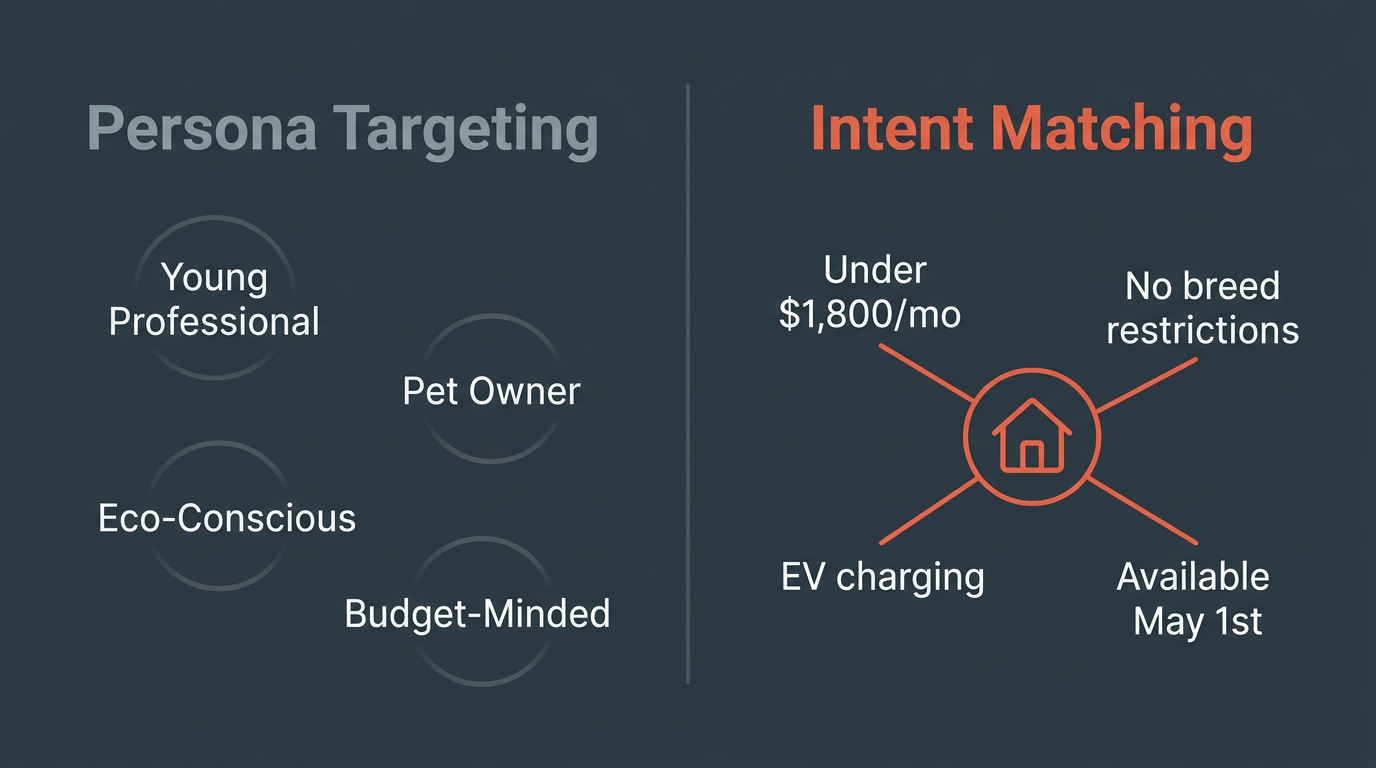
That approximation was good enough when humans were browsing. A renter scrolling Apartments.com could mentally filter listings. They could look at photos and infer walkability. They could read reviews and judge vibe. The persona-targeted ad got them to the listing, and the human did the rest of the matching work.
AI does not browse. AI matches. When a renter asks an AI for apartment recommendations, the model does not think in demographic segments. It parses the query into specific, structured constraints and evaluates every available property against those constraints. The property that satisfies the most constraints with the highest confidence gets recommended. Demographics play no role in that evaluation.
What Intent Signals Actually Look Like
An intent signal is any specific, actionable constraint a renter expresses in a query. Unlike demographics, which are static labels, intent signals are dynamic and composable. A single query can stack multiple signals together, and each one narrows the recommendation set.
| Persona thinking | Intent signal thinking |
|---|---|
| “Young professional” | “Under 15 min commute to downtown” |
| “Pet owner” | “Dog-friendly, no breed restrictions, under 75 lb limit” |
| “Eco-conscious” | “Has EV charging, recycling program, Energy Star appliances” |
| “Budget-minded” | “Under $1,600/mo, utilities included, no application fee” |
| “Family-oriented” | “3BR, good school district, playground on-site, gated community” |
| Vague, static, unmatchable | Specific, dynamic, matchable |
The left column gives AI nothing to work with. “Young professional” is not a searchable attribute of your property. But “under 15 min commute to downtown” is, if you have structured transit data. “Pet owner” is a demographic label. “No breed restrictions, under 75 lb limit” is a matchable fact, if your pet policy is structured as machine-readable data rather than buried in a PDF lease addendum.
The Composability Problem
Renter queries are getting more specific, not less. Early AI adoption looked like “best apartments in Austin.” That is already evolving into multi-constraint queries: “2BR under $2,200 near Domain, EV charging, available August, allows two cats.” Each constraint is a filter. Each filter eliminates properties that cannot prove they match.
This is the composability problem for property marketers. You are not competing on one attribute. You are competing on the intersection of five or six attributes simultaneously. And the only properties that survive all the filters are the ones with structured data for every attribute in the stack.
This is why the digital twin concept matters so much in an intent-driven world. The more complete your structured data, the more intent combinations your property can match. A property with 30 structured attributes can satisfy far more composite queries than one with 8. As covered in The $0 GEO Advantage, this is exactly the kind of specificity that independent operators can deliver and aggregators cannot.
How to Optimize for Intent Instead of Personas
The shift from personas to intent is not abstract. It requires concrete changes in how you structure and publish your property data.
- 1. Audit your data for matchable attributes. Walk through every fact about your property and ask: “Could a renter query for this?” If yes, it needs to be structured. Pet policies, parking types, utility inclusions, commute distances, school districts, noise levels. The GEO Content Audit walks through every room of your digital presence for exactly this purpose.
- 2. Structure attributes at the unit level, not just the property level. “Which 2BR has in-unit laundry?” is a unit-level query. If your data only says “select units have in-unit laundry,” AI cannot confidently match a specific unit. Granularity wins.
- 3. Include constraint-relevant specifics, not just categories. “Pet-friendly: Yes” is a category. “Dogs allowed, no breed restrictions, up to 75 lbs, $300 deposit, 2 pets max” is a set of matchable constraints. When a renter asks “apartments that allow German Shepherds,” the second format answers the question.
- 4. Add temporal data. “Available by May 1st” is an intent signal. “12-month lease starting June” is an intent signal. If your availability data is current and structured, you can match time-sensitive queries that competitors with stale data cannot.
- 5. Encode proximity and access data. “15 minutes from downtown by light rail” is matchable. “Great location” is not. Transit times, walk scores, distances to landmarks, grocery stores, hospitals, schools. These are the signals renters actually search for.
The Targeting Inversion
Traditional marketing works by targeting the renter. You define who you want, then push ads toward that demographic. AI inverts this completely. The renter defines what they want, and AI matches your property to their intent. You do not target the renter. The renter's query targets you.
This inversion changes everything about how you allocate marketing resources. Instead of spending on demographic targeting and ad segmentation, you invest in making your property data complete, structured, and matchable. Instead of asking “Who is our ideal renter?” you ask “What queries should our property be matchable to?” The answer to the second question is your new marketing strategy.
Properties optimized for intent signals will capture the zero-click renter by default. When AI can match your property to a five-constraint query and deliver the recommendation directly, the renter never needs to browse, filter, or compare. You become the answer. And as we have seen, being the specific answer is the entire game.
The Bottom Line
The renter persona was a useful fiction for a broadcast marketing era. It helped you approximate who might be interested in your property when you had no way to know what any individual renter actually needed. That era is ending. AI does not approximate. It matches. And it matches on intent signals, not demographics. The property that wins is not the one with the best persona deck. It is the one with the most complete, structured, matchable data.
Stop asking “Who is our renter?” Start asking “What will our renter ask for?” Then make sure your data answers it.
Make your property matchable to renter intent.
Clync structures your property data so AI can match it to the specific queries renters are actually asking, not the personas you imagined.
Get Started with Clync