GEO Marketing
The “Digital Twin” Property: Why AI Needs a Perfect Mirror of Your Physical Asset
March 22, 2026
Key Takeaways
- • AI recommends what it can fully model. Incomplete data means incomplete confidence, which means weaker recommendations.
- • A “digital twin” is a structured, machine-readable replica of your property that lives across the web, mirroring every physical detail.
- • Most properties have a digital presence that covers maybe 30% of the physical asset. The other 70% is invisible to AI.
- • The completeness of your digital twin directly correlates with how specifically AI can recommend you.
- • Building a digital twin is not a technology project. It is a documentation project. The facts already exist.
Imagine a renter asks ChatGPT a simple question. “Which apartments near downtown Austin have south-facing windows and a walk score above 85?” It's a reasonable question. The renter cares about natural light and walkability. Two things that meaningfully affect daily life.
Now imagine AI tries to answer that question using your property's data. Your website says “bright, sun-filled apartments” in the marketing copy. But there's no structured data about window orientation. No walkability score encoded anywhere AI can read. No machine-readable attribute for sunlight exposure. AI can't recommend you for that query. Not because your property doesn't qualify, but because AI doesn't know it qualifies.
The physical property has the answer. The digital version doesn't. That gap is the problem. And the concept that solves it is the digital twin.
“AI can only recommend what it can model. If your digital presence is an incomplete sketch, you get incomplete recommendations.”
What a Digital Twin Actually Is
In manufacturing and engineering, a digital twin is a virtual replica of a physical asset. Every sensor, every measurement, every operating parameter is modeled digitally. Engineers can simulate, monitor, and optimize the physical asset through its digital counterpart. The concept has been standard in aerospace and industrial operations for years.
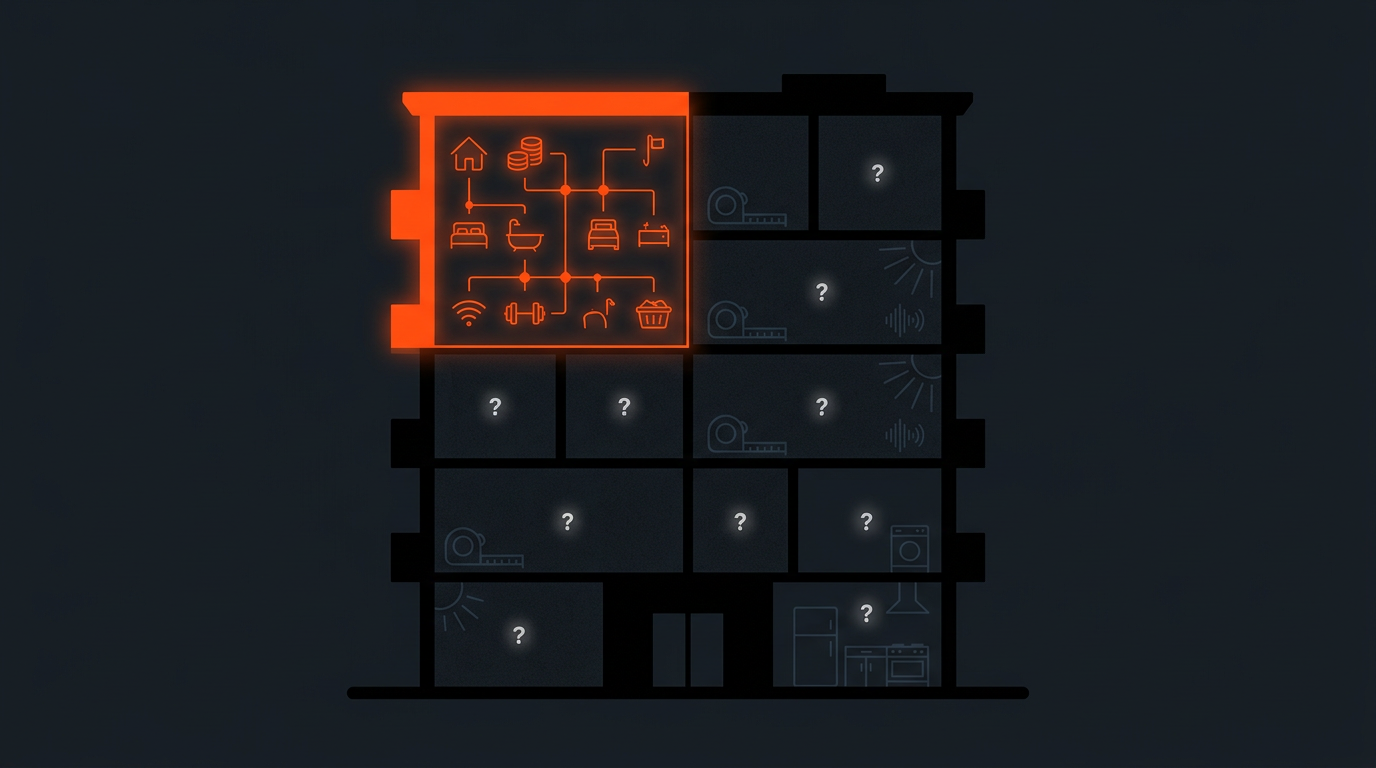
For property management, a digital twin is the same idea applied to your building. Not a 3D rendering or a virtual tour. Those are visual tools for humans. A digital twin is a complete, structured, machine-readable dataset that mirrors every fact about your physical property in a format AI can consume, cross-reference, and recommend from.
Floor plans with actual dimensions. Unit-level attributes (not just property-level). Noise levels by floor. Sunlight exposure by orientation. Walkability and transit scores with source data. Package locker capacity. Storage unit sizes. Ceiling heights. Appliance brands and models. The digital twin captures everything the physical property is, in structured data.
The 30% Problem
Most properties have a digital presence that covers roughly 30% of the physical asset. The basics are there: address, rent range, bed/bath count, a checkbox amenity list, some photos. That covers enough for a human browsing Apartments.com to get the general picture.
But AI is not browsing. AI is modeling. It's trying to build an internal representation of your property that's complete enough to answer any question a renter might ask. When 70% of your physical property has no digital representation, AI fills that gap with uncertainty. And uncertainty means weaker recommendations.
| What most properties digitize | What a digital twin adds |
|---|---|
| Address, rent range | Exact GPS coordinates, rent by unit and floor plan, current specials with terms |
| Bed/bath count | Unit dimensions, ceiling height, window count and orientation, closet sizes |
| Amenity checkboxes | Amenity specifications: gym equipment list, pool dimensions, dog park size, EV charger type and count |
| “Pet-friendly: Yes” | Weight limits, breed restrictions, pet deposit, pet amenities, number of pets allowed |
| Neighborhood name | Walk score, transit score, bike score, nearest grocery (distance), nearest park, school district |
| ~30% of the physical property modeled | ~90% of the physical property modeled |
The left column is what every competitor has. The right column is what makes AI recommend you specifically. As we covered in Why AI Gives Every Apartment the Same Answer, generic data produces generic recommendations. The digital twin is how you break out.
Why Completeness Drives Confidence
AI models operate on confidence scores. When a renter asks a question, the model evaluates how confident it is that a given property matches. More data points mean higher confidence. Higher confidence means a stronger, more specific recommendation.
Think of it like a job interview. A candidate with a detailed resume, specific references, and verified credentials gets a stronger recommendation than one with a vague one-pager. Both might be equally qualified, but the one who documented their qualifications completely is the one the hiring manager can confidently endorse. AI works the same way with properties.
Every attribute you add to your digital twin raises the confidence score. And here's the part most operators miss: the attributes that matter most are often the ones nobody else provides. The $0 GEO Advantage showed that the gap between generic and differentiated data is smaller than you think. The digital twin concept takes that further. It's not about having better data than competitors. It's about having more complete data than anyone else in your market.
Building Your Digital Twin
The good news: this is not a technology project. It's a documentation project. The facts already exist. Your maintenance team knows the ceiling heights. Your leasing agents know which units get morning light. Your residents know the walk score because they live it every day. The digital twin just takes those facts and puts them into structured, machine-readable form.
- 1. Start at the property level. Core entity data: legal name, address, GPS coordinates, year built, total units, property type, management company. This is your foundation. Make sure it matches across every platform (as outlined in the GEO Content Audit).
- 2. Go unit-level. Most properties only have property-level data. A digital twin has unit-level detail: square footage per floor plan, bedroom dimensions, closet types, window counts, appliance models, flooring type. AI can answer “Which 2BR has the largest kitchen?” only if that data exists.
- 3. Add environmental data. Noise levels by floor (ground floor near street vs. top floor). Sunlight exposure by unit orientation. Views (courtyard, street, skyline). These are the attributes renters care deeply about but almost no listing includes.
- 4. Include neighborhood context. Walk score, transit score, bike score. Distance to nearest grocery, pharmacy, park, school. Commute time to major employment centers. This data is freely available and almost nobody structures it for AI consumption.
- 5. Keep it alive. A digital twin is not a one-time project. Availability changes. Pricing updates. Specials rotate. The twin needs to reflect reality in real time. Stale data erodes the trust you built. Freshness signals, like the ones we covered in the Zero-Click Content Blueprint, tell AI that your data is current and reliable.
The Compounding Effect
Digital twins compound in value. Every month your structured data stays consistent and current, AI's confidence in your entity grows. This is the Lindy Effect applied directly: the longer your digital twin has existed with accurate, consistent data, the more AI trusts it.
Properties that start building their digital twin today get a head start that late movers can't buy. You can't shortcut six months of consistent, verified data. You can't fake entity authority built through real-time accuracy across multiple platforms. The twin rewards patience and punishes procrastination.
The Bottom Line
Your physical property is rich with detail. Your digital presence probably isn't. Every missing attribute is a question AI can't answer on your behalf. Every undocumented fact is a renter query that goes to a competitor who documented it. The digital twin closes that gap. It mirrors your physical asset in structured data so AI can model it completely, trust it fully, and recommend it specifically.
AI recommends what it can fully model. The more complete your digital twin, the more confidently AI recommends you. The facts already exist. Structure them.
Build your property's digital twin.
Clync creates the complete, structured data layer that mirrors your physical asset in a format AI can search, trust, and recommend by name.
Get Started with Clync