GEO Marketing
The $0 GEO Advantage: How Individual Properties Can Out-Optimize the Platforms
March 15, 2026
Key Takeaways
- • AI does not reward marketing budgets. It rewards data specificity, factual consistency, and structured entity information.
- • Aggregators are structurally unable to optimize at the individual listing level. Their scale is their weakness in GEO.
- • A 30-unit independent operator with detailed structured data can outrank a national platform on specific renter queries.
- • The cost of building GEO-ready data is near zero. The information already exists inside your leasing office.
- • Specificity beats domain authority when AI is answering a real question from a real renter.
Picture two properties competing for the same renter. One is listed on a national platform backed by a $500M annual marketing budget, thousands of engineers, and domain authority built over two decades. The other is a 30-unit independent community with a leasing team of three. In the SEO era, this wasn't a fight. It was a formality. The platform won every time.
In the GEO era, that math is completely different. When a renter asks ChatGPT “Which apartment near Ballard has covered parking, allows large dogs, and includes a storage unit?” the AI doesn't check who has the bigger marketing budget. It checks who has the better data. And that's a game the small operator can win.
“AI doesn't care about your ad spend. It cares about your data.”
Why the Platform's Scale Is a GEO Weakness
Aggregators manage millions of listings. That's the business model. But it's also the constraint. When you manage millions of listings, you standardize everything. Every property gets the same template. Same fields. Same checkbox amenities. Same character limits. The platform can't hand-craft structured data for each individual listing because the economics don't work at that scale.
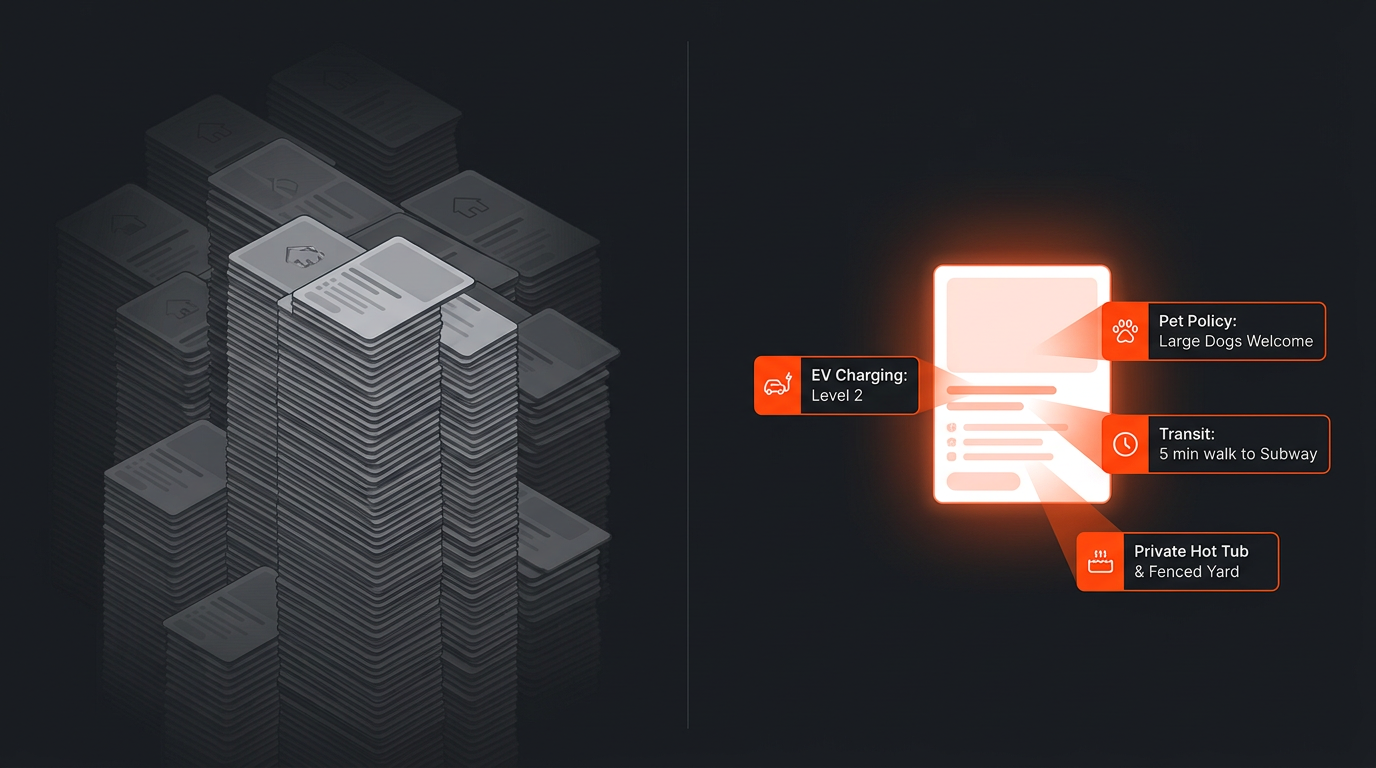
That means every listing on an aggregator looks the same to AI. As we covered in Why AI Gives Every Apartment the Same Answer, when every property feeds the same standardized fields through the same templates, AI has no raw material to differentiate one from another. The platform's strength in SEO (massive domain authority, millions of pages) becomes its weakness in GEO (generic, undifferentiated data at the listing level).
You, the individual operator, don't have that constraint. You manage one property. Maybe five. You know every unit, every amenity, every policy detail. You can encode that knowledge into structured data that no platform has the incentive or ability to create for you.
What “$0 GEO” Actually Means
The information that makes you GEO-competitive already exists. It's in your leasing binder. It's in the answers your team gives on the phone. It's in the details renters ask about during tours. The cost isn't acquiring new information. The cost is structuring what you already know.
| What you already know | What it becomes as structured data |
|---|---|
| “We allow dogs up to 80 lbs, no breed restrictions” | Schema.org petPolicy with weight limit, breed policy, deposit amount, pet amenities |
| “We have 4 EV chargers in the garage” | Typed amenity: EV charging, count: 4, type: Level 2, location: covered garage |
| “Light rail is a 6-minute walk” | Transit proximity: station name, distance, walk time, line served |
| “We include washer/dryer in every unit” | Amenity: in-unit laundry, type: full-size, brand: Samsung, included in rent: yes |
| Locked in your leasing team's heads | Machine-readable facts AI can cite |
None of that costs $500M. The data already exists. The platform can't replicate it because they don't have access to that level of detail for millions of listings. But you do, for your property, right now.
Specificity Beats Authority on Specific Queries

Domain authority matters for broad queries. If someone asks AI “apartments in Dallas,” the platform with 20 years of domain authority and 50,000 Dallas listings will probably win. That's the SEO game, and the platforms own it.
But renters don't ask broad questions anymore. They ask “Which apartment in Uptown Dallas allows cats, has a balcony, and is within walking distance of the Katy Trail?” That is a specific query. And when AI is answering a specific question, it doesn't defer to whoever has the most pages. It defers to whoever has the most precise, verifiable answer.
This is exactly the dynamic we outlined in Third-Party AI Dependency. A property with even basic GEO structuring can outmaneuver a $500M platform on specific prompts because the platform isn't optimized at the listing level. Your competitor isn't a well-optimized Apartments.com. It's an unoptimized one. And that's a competitor you can beat with data alone.
The Small Operator's GEO Playbook
- 1. List every fact a renter could ask about. Walk your property. Open your lease. Look at your Google reviews. Every question a renter has ever asked your leasing team is a data point AI could use to recommend you. Write them all down.
- 2. Structure those facts for machines, not humans. Following the approach in the Zero-Click Content Blueprint, encode your property's unique facts as Schema.org markup and JSON-LD. Pet policies with actual weight limits. Parking with actual charger counts. Transit with actual walk times.
- 3. Be consistent everywhere. Every platform where your property appears is a data node AI cross-references. Your website, Google Business Profile, ILS feeds, and social media should all tell the same factual story. Conflicting data creates doubt. Consistent data creates trust.
- 4. Fill the fields nobody else fills. Aggregators give you a template with 20 fields. Most operators fill 12 of them. Fill all 20. Then add 30 more on your own site that the template never offered: walkability scores, noise levels, package locker capacity, storage unit sizes, neighborhood-specific details.
- 5. Update with real-time specificity. Don't say “units available.” Say which floor plans, which move-in dates, which specials. Live, specific data signals freshness to AI, and freshness is a trust signal.
Why This Window Won't Stay Open
Right now, less than 10% of properties have any meaningful GEO optimization. That's the opportunity. The bar is on the floor. A property that builds structured data today doesn't just compete. It dominates its submarket in AI search because nobody else is even trying yet.
But GEO authority compounds. Every month of consistent, structured data builds entity trust with AI models. That trust accumulates and becomes harder to displace over time. The property that starts today has a six-month head start on the one that starts in the fall. And a year from now, that head start may be insurmountable.
The platforms will eventually catch up. They'll start building better listing-level structured data. They'll hire GEO teams. They'll invest in entity authority at scale. But they haven't done it yet. And the properties that move first will have already cemented their position with AI models before the platforms even begin.
The Bottom Line
You don't need a $500M budget to win in GEO. You need the facts about your property, structured in a way machines can read, consistent across every platform, and more specific than anything an aggregator template can produce. The small operator's advantage isn't budget. It's proximity to the truth about what makes their property worth recommending.
In the AI era, the property that wins isn't the one with the biggest budget. It's the one with the best data. And no one knows your property better than you.
Turn what you already know into what AI recommends.
ClyncGEO structures your property's unique facts into the data layer that AI searches, trusts, and cites by name.
Get Started with ClyncGEO