GEO Marketing
The Invisible Filter: Why AI Might Be Shadow-Banning Your Property
February 26, 2026
Key Takeaways
- • AI models don't just read star ratings — they perform deep sentiment analysis across reviews, social media, news, and public records.
- • Properties with recurring negative sentiment themes (safety, mold, billing disputes) get quietly filtered out of AI recommendations.
- • “Digital Sentiment” is becoming more important than keywords for AI visibility.
- • A property with perfect structured data can still be invisible if its reputation signals are negative.
- • Managing sentiment is now a GEO strategy, not just a PR strategy.
- • ClyncGEO monitors and optimizes both structured data and digital sentiment signals.
We've covered the mechanics of GEO. Structured data. Zero-click discovery. Getting into the top three. Building data bridges between your property and AI. But there's another layer to AI visibility that almost nobody in property management is talking about yet. And it might be the most important one.
AI models have a “vibe check.” Before they recommend your property to a renter, they don't just verify your data. They assess your reputation. And they do it by analyzing signals most property managers don't even know exist.
“Find me a safe, well-managed apartment complex in Ballard with good reviews and no history of maintenance issues.”
That prompt changes everything. The renter didn't ask for the cheapest option or the newest building. They asked for “safe” and “well-managed.” To answer that, the AI has to go beyond your listing data. It has to evaluate your reputation across the entire digital landscape.
How AI Reads Your Reputation
Traditional reputation management was about star ratings. Get your Google reviews above 4.0, respond to the angry ones, and move on. AI models operate on an entirely different level. They don't just count stars. They read every word of every review and extract the sentiment behind it.
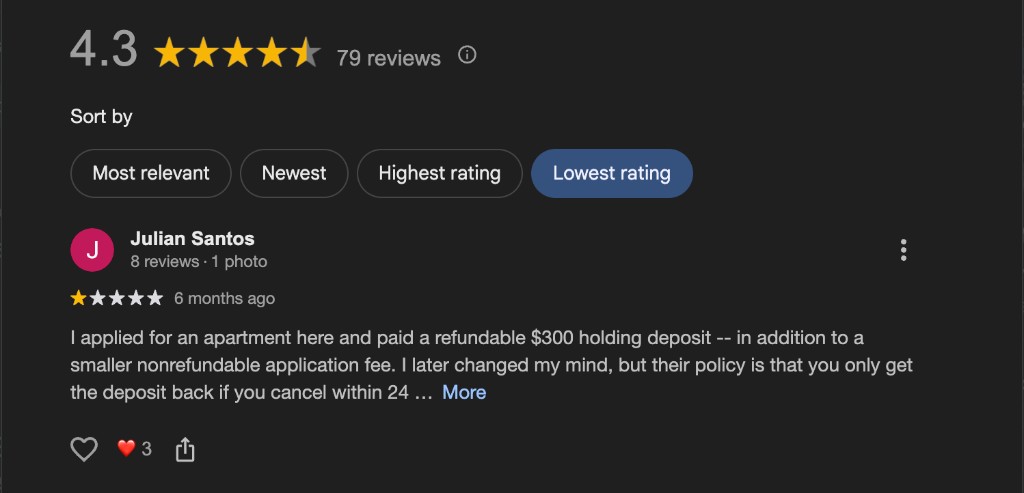
A 4.2-star property isn't necessarily “safe” to recommend. If the AI detects recurring themes of “mold in the bathroom,” “management never responds,” or “felt unsafe in the parking garage,” those themes matter more than the aggregate number. Meanwhile, a 3.8-star property with reviews that mention “responsive maintenance team” and “quiet, clean building” might score higher on the signals that actually drive AI recommendations.
But reviews are just the beginning. AI models are increasingly capable of pulling signals from across the web:
- Google and Yelp reviews — full text sentiment analysis, not just star counts
- Social media mentions — Reddit threads, Twitter/X posts, Facebook group discussions about your property
- News articles — local news coverage of building incidents, lawsuits, or code violations
- BBB and complaint databases — formal complaints and resolution patterns
- Court records — eviction filing patterns, tenant lawsuits, code enforcement actions
- Community forums — apartment review sites, neighborhood discussion boards, Glassdoor reviews of the management company
The Invisible Filter
Here's what makes this different from a bad Yelp review. When a renter reads a negative review on Google, they can weigh it themselves. They can decide the reviewer was unreasonable, or that the issue has been fixed. They have context and judgment.
AI doesn't give you that second chance. When an AI model evaluates properties to recommend, it runs its sentiment analysis silently. There's no notification. There's no “your property was excluded because of negative sentiment.” Your property simply doesn't appear in the recommendation. The renter never sees your name. You never know you lost the lead. It's a shadow ban.
And it compounds. Remember the compounding effect of GEO authority? Sentiment works the same way — but in reverse. Every month that negative signals sit unchallenged, AI models reinforce their assessment. The longer you wait to address sentiment issues, the harder they become to overcome.
Digital Sentiment vs. Keywords: The Paradigm Shift
For 15 years, property marketing was about keywords. “Luxury apartments downtown Seattle.” “Pet-friendly rentals near transit.” Stuff the right keywords into the right places, and Google would send you traffic. That playbook still has value for SEO. But AI doesn't think in keywords.
AI thinks in entities and trust. It asks: “Is this property what it says it is? Do the signals across the web confirm or contradict the listing data? Would recommending this property reflect well on me as an AI assistant?” That last question is the key. AI models are optimized to give good recommendations. A bad recommendation erodes user trust in the AI itself. So the AI is naturally incentivized to filter out properties with questionable reputations.
This means your “digital sentiment” is now a ranking factor. Not in the SEO sense — in the GEO sense. It's not about where you rank in a list. It's about whether you appear in the answer at all. And no amount of structured data will save you if the sentiment signals say “stay away.”
What You Can Do About It
The good news: sentiment is manageable. Unlike some ranking factors, digital sentiment is largely within your control. It starts with operations and ends with optimization.
- 1. Audit your digital footprint. Google your property name. Check Reddit. Search for your management company on BBB. Read your reviews — not the stars, the actual text. What themes keep coming up? Those themes are what AI is reading too.
- 2. Fix the operational issues first. No amount of digital strategy fixes a mold problem or an unresponsive maintenance team. If the complaints are legitimate, fix the root cause. AI will eventually notice the improvement in new reviews.
- 3. Respond to every review thoughtfully. AI models analyze response patterns. A property that responds to negative reviews with empathy and specific actions scores differently than one that responds defensively or not at all.
- 4. Generate positive sentiment intentionally. Happy residents rarely leave reviews unprompted. Create touchpoints that encourage satisfied residents to share their experience. Move-in follow-ups, maintenance completion surveys, renewal check-ins.
- 5. Monitor continuously. Sentiment shifts. A single incident can change your digital profile overnight. Ongoing monitoring ensures you catch issues before they compound into an AI-level reputation problem.
ClyncGEO approaches this as a complete picture. Structured data gets you into the AI's consideration set. Entity authority builds trust. But sentiment is the filter that determines whether the AI actually recommends you. We monitor and optimize all three layers because in the agent era, leaving any one of them unaddressed creates a gap that competitors will fill.
The Bottom Line
Perfect data with a bad reputation is still invisible. AI models aren't just checking whether your property exists in their data. They're checking whether your property is worth recommending. That judgment is made from every review, every mention, every signal your property has ever left on the internet. The properties that manage their digital sentiment as carefully as they manage their structured data will be the ones AI chooses to recommend.
In the AI era, your reputation isn't what you say about yourself. It's what every signal on the internet says about you. And AI is reading all of it.
Don't let sentiment be the reason AI skips your property.
ClyncGEO monitors structured data, entity authority, and digital sentiment — the three layers that determine whether AI recommends your property or filters it out.
Get Started with ClyncGEO